Breaking the Limiter
How AI removed the syntax barrier and unleashed the Builder's Mind
I have been reflecting a lot lately. Not just on my journey using AI to build software and games, but on my own history.
In my previous article, I wrote about learning to code to gain independence. It was a manual, deliberate process of understanding the machine. But recently, something shifted. The “learning” phase has evolved into something faster, more fluid, and more powerful.
Since I was a kid, I always lived in the intersection of computers and art. I loved them both equally. But the world - and the education system - often forces a choice. I ended up leaning into Arts because it felt stronger at the time, but the itch for the logic of the machine never went away.
The industry tries to keep these boxes separate: Designer vs. Engineer. Creative vs. Builder. But I never fit perfectly into either. I consider myself both, and I am willing to stay in both.
Builder
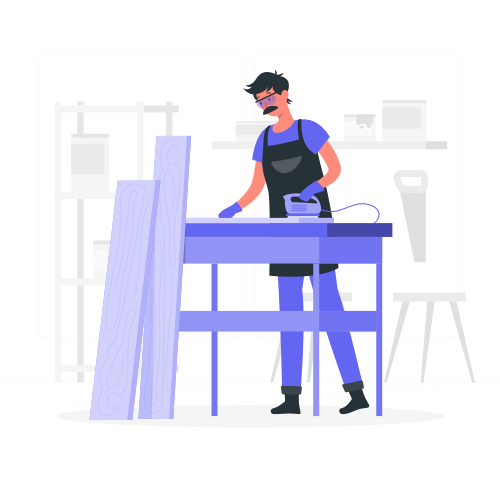
My primary focus has always been Human-Centered Design. I believe that relationships form the foundation of how we experience the world - shaping our expectations and fostering emotional connections.
My curiosity to understand the truth of these connections is what wakes up the “Builder” in me.
A static mockup can be beautiful, but it is often a lie. It promises an experience it cannot deliver. I found that I couldn’t just “design” the journey; I had to “engineer” the path to verify it. I felt a creative impatience - I didn’t want to wait for a developer or engineer to prove a concept worked; I wanted to see it break, and fix it, myself.
When I design a UI, I don’t just want to draw a door; I want to build the hinge, install the lock, and feel the click.
Fun fact: Across my career, I’ve always hacked reality to find the truth of the experience.
- The IR Remote (2012): I built a distributed system using Adobe AIR to connect a TV and a smartphone via Wi-Fi, just to test the latency and feel of an IR signal.
- The Cooktop (2013): I built a 1:1 induction cooktop using three tablets and real metal pots, so users could feel the literal weight of their actions.
- VR Prototypes (2018): I used Unreal Engine to build immersive virtual prototypes for kitchen appliances, allowing us to test ergonomics and scale without building expensive physical models.
- Home Assistant (2025): I am using ESPHome to handcraft IoT prototypes for outdoor living contexts, testing automation logic directly in the wind and rain of the real environment.
Knowing how to code these prototypes always felt like a superpower. It allowed me to move faster than external agencies and surprise stakeholders who didn’t expect a functional proof-of-concept.
But deep down, it also came with a heavy dose of impostor syndrome. I knew I wasn’t a “real” engineer. I was hacking my way through, paying a heavy tax for every feature I built.
Syntax
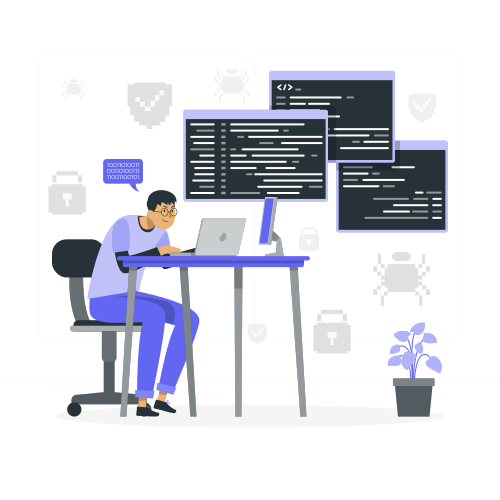
The tax is Syntax.
For someone who thinks in both design and code, the vision is instant. You see the system, the flow, the outcome clearly in your head. But to get it out, you have to translate that vision into strict machine grammar.
You have to stop focusing on the Experience - the flow, the logic, the user’s emotion - to suddenly become a dictionary for machine logic. You drop the high-level puzzle to hunt for a missing bracket or decode a cryptic error message.
This context switch is the Limiter.
It acts like a speed bump in the flow of creativity. Every time you stop to fix a syntax error, the vision fades a little. The “creating” turns into “labor,” and the innovative momentum is lost to the friction of the tool.
Studio
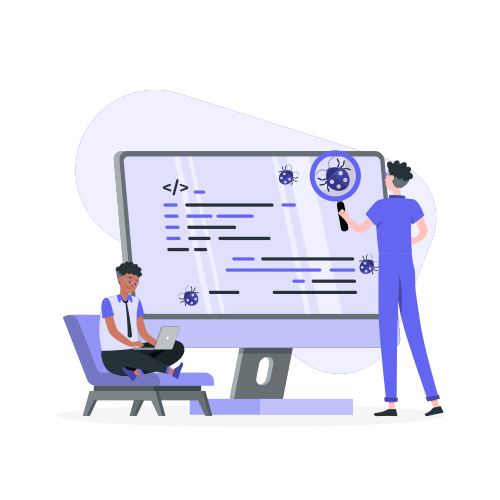
This is why I am currently so pumped. AI has broken the limiter.
AI handles the syntax. It acts as the translation layer, allowing me to speak in “Vision” and get back “Code.” The manual labor - the boilerplate, the error handling, the syntax checks - is outsourced to the machine, allowing me to stay in the high-level “Builder” mode.
This freedom triggered a new concept for me: The Studio of Two.
It is the destination this new speed has allowed me to reach. Because I am no longer bogged down by the “How,” I can act as a full production house of one. The AI is my technical co-founder, living on my machine, understanding my context, and executing the blocks I define.
I am not just designing anymore. I am building. And for the first time in my career, the tool is Finally fast enough to keep up with the thought.
Thank you for sticking with me and I hope you enjoyed it.