Design Ops
Enabling and empowering people at scale.

Process is not a rigid mold - it is a blueprint.
Most companies have “bloatware” processes. They add meetings, checkpoints, and documents that slow everyone down. I treat DesignOps like lean manufacturing: cut the waste, optimize the flow, and let the humans do what they do best.
However, efficiency must be balanced with the human capacity to adapt. I prioritize Predictive Experience - ensuring transitions don’t add excessive cognitive load. While drastic change is sometimes necessary, it must always respect the human side of the organization.
One of my life goals is to optimize the world around me. I love puzzles. I want to make people’s lives better not by adding more work, but by removing the friction that slows them down.
I prioritize four different areas in my design work.
Community

Community is the operating system.
It’s the most specific layer of DesignOps because it deals with the unpredictable: humans. It’s not just about the immediate team, but aligning every stakeholder. Learning and sharing aren’t “nice-to-haves” - they are the mechanism for increasing empathy and velocity.
A community only takes shape when people feel safe enough to trust each other.
Development
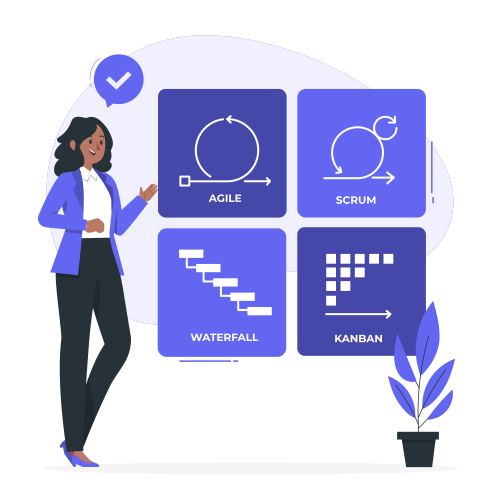
Delivery is the bridge between idea and reality.
To ensure an experience involves more than just “shipping.” It requires balancing requirements, resources, and time without breaking the team. I focus on removing ambiguity: clear channels, well-defined workflows, and reachable goals.
Building bridges isn’t enough; you have to maintain them. Everybody must be clear on the Why, What, How, and When. without that, “Agile” is just chaos with a different name.
Quality

Quality is an engineered outcome.
You cannot test quality into a product; you have to design it in. High-quality products that outperform the competition start with valid insights, not guesses.
I challenge every assumption. By continuously validating hypotheses with data, we replace “I think” with “I know.” Knowing essentially who you are building for isn’t just empathy—it’s the only way to guarantee ROI.
Scale

Scaling isn’t just getting bigger; it’s getting fitter.
It’s about making the process fit like a bespoke suit. There is no “Spotify Model” that works for everyone. Every team needs to find the topology that matches their specific capabilities.
My goal is efficiency and consistency, creating just enough structure to support growth without suffocating innovation. You need the right metrics not just to report status, but to diagnose health.