The Expectation Effect 2/3
The Designer's Duality

In Part 1, we recognized that “Expectation” is the invisible parameter defining the user’s experience. But before we can manage the user’s expectations, we have to face a harder truth: We are also subject to the Expectation Effect.
Innovation requires breaking patterns. But breaking patterns triggers resistance - not just from users, but from stakeholders and from ourselves. And friction starts when each party has a different understanding/expectations of the outcome or user experince the product must provide. User/consumer research is a powerful tool, but if done wrong it can be a double edged sword. Making the wrong questions or misunderstanding the user’s needs can lead to a product that fails to deliver on its promise.
While working at Electrolux, I stumble across a report where there was one question regarding temperature control on a fridge. The question was: “Rate from 1 to 5 how important is it to control the temperature of your fridge.” (1 being the least important, 5 being the most important) The answer was around 4.5, even if most of them never changed the temperature of their fridge (part of the same research). Most people take this data as true since come from the users, without trying to understand the invisible parameter.

After digging deeper, I realised that the hidden meaning is around trust, or lack of trust that the fridge will work as expected, based on past experiences. So, the importance to temperature control is not about the user’s need to control the temperature, but to have a safeguard in case the fridge fails to work as expected.
This frames the “Duality of Expectation” and how it spread quickly. The user “buys a feature” based on a potential failure, not on a need. The business sees this as a need, fearing that people won’t buy the fridge if it doesn’t have the feature (safeguard). The designer, aware of the hidden meaning, faces resistance for challenging the “data”.
The Paradox of Trust
Here lies the Designer’s Duality: You must doubt the data while trusting your ability to interpret it.
The fridge story illustrates a trap. The data said “temperature control matters.” It wasn’t lying - but it wasn’t telling the whole story either. The real insight was hidden beneath the surface, waiting for someone to dig deeper.
This is where design intuition lives. Not in ignoring data, but in reading between the lines. The ability to sense that a 4.5 rating on “temperature control importance” doesn’t mean what it appears to mean.
But here’s the tension: challenging user research feels heretical. The data comes from users. It’s quantified. It’s “objective.” How do you tell a stakeholder that the research is technically correct but fundamentally misleading?
This is the Designer’s daily battle: standing in front of a spreadsheet that says one thing, while your experience whispers something else. And you must find a way to articulate the whisper in a language that spreadsheets understand.
The paradox deepens when you realise that your own interpretation is also shaped by priors. Years of designing fridges might make you blind to certain assumptions. The very expertise that gives you pattern recognition can also calcify into bias. So you must doubt even your own first read - while still trusting your ability to dig deeper.
Navigating the Sea of Miss-Expectations
You are now caught between three currents:
- The User - who gives you data shaped by fears they can’t articulate. They rate temperature control as important, but what they really want is reassurance. They can’t tell you this because they don’t know it themselves.
- The Business - who interprets that data as a hard requirement, fearing lost sales if the feature is missing. The product manager sees “4.5 importance” and adds it to the spec. Marketing writes copy about “precision temperature control.” The feature becomes load-bearing before anyone questions its foundation.
- Yourself - who sees the hidden meaning but must justify an alternative path. You know the real insight, but you’re one voice against a machine that has already committed resources based on the surface reading.
Each party is operating on a different expectation of what the product should be. And each expectation is based on a different “prior” - cached models from past experiences, competitive pressures, or professional instincts.
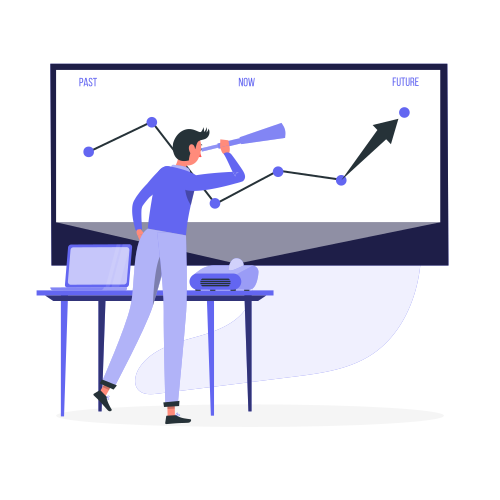
This is the sea of miss-expectations. Everyone is navigating by a different map.
The danger isn’t disagreement - it’s invisible agreement. When everyone nods at the same data but interprets it differently, the project moves forward with false alignment. The misalignment only surfaces later, when the product fails to resonate and no one can agree on why.
The Designer’s role isn’t just to design the product. It’s to align these maps - or at least to surface the differences before they become expensive. This requires a specific kind of courage: the willingness to say “I believe we’re all looking at different things” in a room full of people who think they’re looking at the same thing.
The solution for the fridge wasn´t to remove the function but to adapt it to face the hidden expectation. Modern fridges have advanced temperature control that makes manual setting almost irrelevant - often not even recommended. We strategically hide the temperature control in the temperature feedback, instead of plus and minus buttons, the user can touch the digits to adjust the temperature. It keeps the function available while declutering the UI. This innovation granted us a patent.
Trusting the Instinct
So what does the Designer trust?
Not the raw data. Not the stakeholder’s interpretation. Not even their own first instinct - which is also shaped by priors.
What you trust is your process of interrogation. The willingness to ask “why” until you hit the real need. The pattern recognition that comes from years of watching users say one thing and do another.
I’ve sat through hundreds of user tests. I’ve watched people struggle with interfaces and then tell me it was “easy.” I’ve seen them praise features they never used and complain about problems they invented post-hoc. After a while, you develop a sixth sense - not for truth, but for incongruence. When the words don’t match the behaviour. When the rating doesn’t match the emotion.
This is what we call “gut feeling,” but it’s not mystical. It’s accumulated experience - a trained intuition that detects when the surface story doesn’t match the underlying behaviour. It’s the pattern recognition of someone who has been fooled before and learned to look for the tells.
The skill isn’t certainty. It’s calibrated doubt:
- Doubt the obvious - the 4.5 rating, the stated preference, the feature request. These are symptoms, not diagnoses.
- Trust your dig - your ability to find the emotional need behind the feature, the unspoken need behind the stated want.
This isn’t arrogance. It’s the Designer’s core competency: seeing the invisible parameter that everyone else missed. And more importantly, having the patience to keep digging when the first answer feels too easy.
The Voyage
Before you can manage your user’s expectations, you must first manage your own - and everyone else’s at the table.
This is the voyage. The process that happens before the product even reaches the user. The internal alignment. The negotiation of maps. The translation of whispers into spreadsheet-speak.
The crucial role you need to aim here is not the captain of the ship, but the navigator. You are not steering the ship, but you are responsible for making sure that the ship is going in the right direction. You are the one that studied the maps, the currents, the winds, and the stars. You are the one that made all the projections, run all the tests and even with a perfect plan you stay alert because you know how predictably unpredictable humans are, and maybe there is an iceberg just around the corner.

The Duality is not a weakness to overcome, but a stance to cultivate. Trust your ability to interpret. Doubt the interpretation until you’ve tested it. Hold both at once, and you become resilient enough to navigate the miss-expectations without losing your sense of direction.
But here’s the hard truth: even when you navigate the voyage successfully - when you’ve aligned the maps, found the real insight, and built the better solution - you still face a second sea - the hallucinated reality.
In Part 3, we will confront what happens when the product finally meets the user. When you’ve done everything right, and they still resist it. This is The 9x Barrier: the asymmetric weight of loss aversion that makes humans cling to the familiar, even when the new is objectively better.
And this is where gut feeling meets its ultimate test. Because the user’s resistance isn’t a flaw in your research or your design. It’s biology. And biology doesn’t negotiate.
Continue to Part 3: The 9x Barrier
Thank you for sticking with me and I hope you enjoyed it.