Digi-Physi
Why adding an App doesn't fix a broken Product
Digi-Physi
It might sound silly, but the order of words matters. "Digital-Physical" is not the same as "Physical-Digital."
In my career, I've seen companies struggle because they treat these two directions as identical. They assume that because they mastered one world, they can simply "add on" the other. But the gravity of atoms is very different from the fluidity of bits.
Understanding which term comes first - which world is your native soil - influences everything about how you plan, execute, and succeed in the modern era.
Direction

The difference lies in the origin point and the expansion vector.
- Digi-Physi (Digital → Physical): Companies like Google or Spotify. They started in the cloud, mastering data and software speed. When they move to physical (Pixel phones, Car Thing), they often treat hardware as a "container" for their software. They struggle with supply chains and manufacturing tolerances.
- Physi-Digi (Physical → Digital): Companies like Philips, Electrolux, or LEGO. They started with atoms, mastering interaction and durability. When they move to digital (Hue app, Smart Home), they often treat software as a "remote control" for their hardware. They struggle with update cycles and user engagement.
Fun fact: In the physical world, you measure in millimeters and worry about mold costs. In the digital world, you measure in pixels and worry about server costs. Knowing which language you speak by default is the first step to learning the other.
Overrated

I am going to say something controversial: Digital is often overrated.
If your product is purely digital, fine. But for the rest of the world, we have become obsessed with the screen at the expense of the object. The majority of UX content today assumes the "Product" is an app.
Product (noun)
- an article or substance that is manufactured or refined for sale.
- formerly: a chair, a toaster, a car. (To my fellow Industrial Designers: I know, they stole our title. But we move on.)
- currently: an app, a SaaS platform, a token.
Because software is easier to change - just log into Figma and push an update - we tend to use it as a crutch. Physical companies, struggling to keep up with the "Digitalization Era," often take the short path: "Let’s build an App!" or "Slap a touch screen on it!"
They believe digital will solve the product's problems. But if the physical experience is broken, an app is just a digital band-aid on a physical wound.
Even worse, the digital component is often secondary to the user's goal, yet it demands primary attention.
- The user wants to toast bread (primary), not update firmware (secondary).
- The user wants to open the door (primary), not pair bluetooth (secondary).
When we force users to engage with a digital layer to access a physical utility, we aren't adding value; we are adding friction. And users getting angry and frustrated is not a surprise. They don't hate the digital because they are technophobes; they hate it because it is standing in the way of the physical reality they actually paid for.
Value
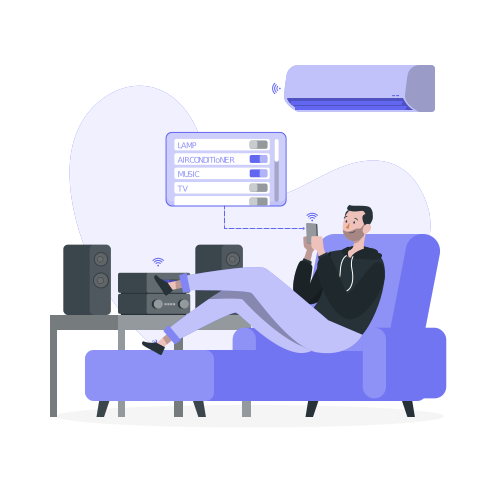
The biggest challenge for a Physical company isn't building the app; it's defining the added value.
Sometimes, there is no value in connecting a product. And that is fine. I would rather have a dumb, reliable toaster than a smart one that needs a firmware update to brown my bread.
Building a digital experience where it isn't needed drains resources that could be used on real improvements. The goal shouldn't be "Digitalization" for its own sake. The goal should be understanding the user's need and use technology to elevate instead of complicate.
- Sometimes the digital value isn't for the consumer at all—it's for the company (data, supply chain insights).
- Sometimes the digital value is invisible (predictive maintenance).
Understanding the product and the service it provides is crucial. Only then can you align with the user needs and identify opportunities that are actually worth translating into code.
Thank you for sticking with me and I hope you enjoyed it.